
Timeline planning: how to see your week without losing today
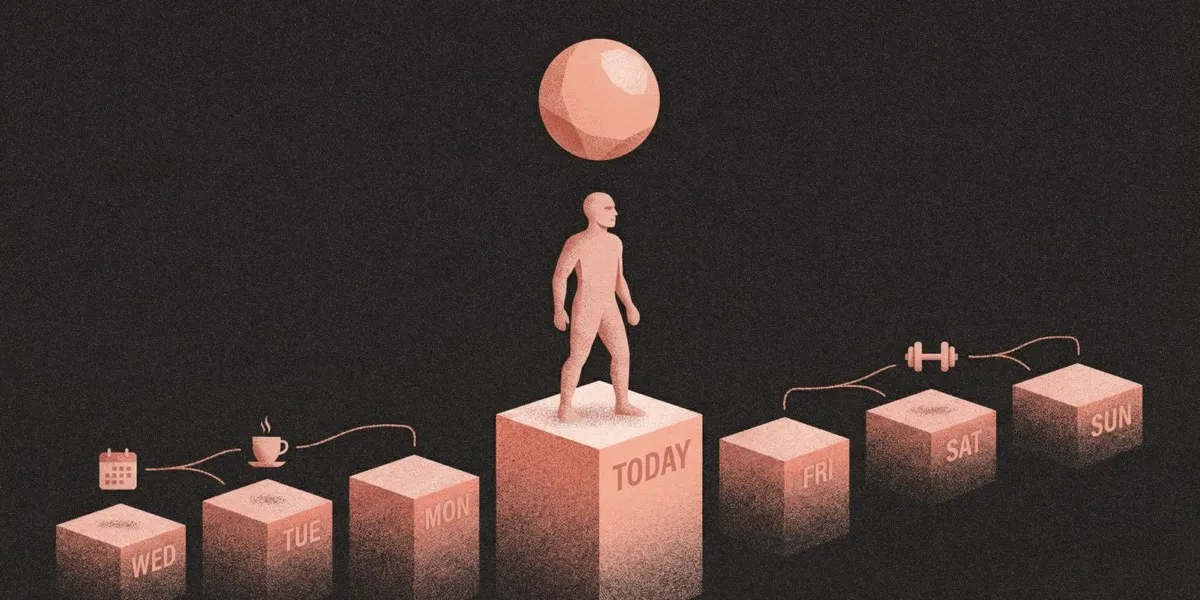
Think about the last time you opened your planner on a Monday morning. You saw today (a blank page, maybe some leftover tasks) and nothing else. Yesterday was hidden behind a tab or buried under a swipe. Tomorrow did not exist yet. You were standing in a room with no windows, planning a journey with no map.
Most planning tools treat each day like a sealed envelope. You open today, deal with what is inside, close it, and repeat. But your life does not work in sealed envelopes. What you did on Tuesday shapes what matters on Wednesday. The project you finished last week determines what you should start this week. Context is everything, and most planners throw it away the moment midnight passes.
Timeline planning keeps all of that context visible. Instead of isolated daily pages, you work within a continuous, scrollable sequence of days, past, present, and future, stacked vertically so you can see where you have been and where you are headed without losing sight of right now.
New to the idea? We wrote a full guide to what timeline planning is, where it comes from, and why it works.
This is how to use it, and why it changes the way you think about your week.
The problem with single-day planning
A standard daily planner gives you one view: today. That design choice seems logical. After all, you can only act in the present. But it creates three problems that slowly undermine your productivity.
You lose the thread
When yesterday disappears from view, you lose the narrative of your work. A task you moved from Monday to Tuesday to Wednesday stops feeling like progress. It starts feeling like failure. Without visible history, you cannot tell the difference between a deliberate delay and chronic avoidance. Research on goal monitoring supports this: a meta-analysis by Harkin et al. (2016), published in Psychological Bulletin, found that the simple act of monitoring your progress toward a goal significantly increases the likelihood of achieving it. When your past days vanish, that monitoring disappears with them.
You plan in a vacuum
Planning without seeing what came before or what lies ahead is like writing a sentence without reading the paragraph it belongs to. You overcommit on Mondays because you forgot how draining Friday was. You underplan Thursdays because you cannot see Friday’s deadline. Each day becomes a guess instead of a deliberate decision.
You miss your own momentum
Most planners never show you the evidence that you are moving forward. A completed Monday and a productive Tuesday, visible right above today’s page, are solid proof that you are capable. Albert Bandura’s research on self-efficacy (the belief in your ability to succeed) demonstrated that past performance accomplishments are the most powerful source of that belief (Bandura, 1977, Psychological Review). A planner that hides your past robs you of your strongest motivational fuel.
What timeline planning actually looks like
Timeline planning is not a calendar. A calendar divides your day into hourly slots and asks you to assign activities to specific times. That works for meetings and appointments. It does not work well for the fluid, unpredictable nature of real work, the kind where a task takes forty minutes instead of twenty, or where you need to capture a thought that does not belong to any time slot.
A timeline planner organizes your days as flexible pages stacked in sequence. Each day is a page where you write notes, capture tasks, jot down ideas, whatever that day holds. The pages scroll vertically so you can move backward through yesterday or forward into tomorrow without ever closing the current day.
Picture a notebook where the pages are days, arranged in order, and you flip through them freely. No hourly grid. No rigid structure. Just a continuous flow of days, each one a space for whatever you need it to be.
Timeline planning vs. calendar planning
The distinction matters because these tools solve different problems.
Calendar planning answers: “When exactly does this happen?” It is time-bound, slot-based, and works best for events with fixed start times. Essential for scheduling. Not great for thinking, reflecting, or tracking the messy reality of daily work.
Timeline planning answers: “What does my week look like as a whole?” It is day-bound, flexible, and works best for tasks, notes, and plans that do not fit into hourly blocks. You write freely on each day’s page. You scroll to see the bigger picture.
Most people need both. A calendar for appointments. A timeline planner for everything else.
How to practice timeline planning
You do not need special training or a complex system. Timeline planning is a perspective shift more than a methodology. Here are four techniques that make it practical.
1. Start each day by scrolling backward
Before you plan today, look at yesterday. Then the day before. Spend thirty seconds reviewing what you accomplished and what you moved forward. This is not about guilt. It is about context. You are reading the previous paragraphs before writing the next one.
This does two things. It reminds you of unfinished work that still matters. And it shows you what you already handled, building the self-efficacy Bandura described. You are not starting from zero. You are continuing.
2. Plan with a week-long peripheral vision
When you sit down to plan your day, scroll forward through the next three to five days. Not to plan them in detail, just to see what is coming. Deadlines, events, approaching due dates. This peripheral vision prevents the surprise that derails so many carefully planned days.
A review by Claessens, van Eerde, Rutte, and Roe (2007) in Personnel Review found that planning behaviors, particularly those considering multiple days at once, were consistently associated with greater perceived control of time and lower stress. Seeing your week at a glance is one of the simplest forms of this behavior.
3. Use your history as a pacing tool
After a week or two of timeline planning, your visible history becomes a pacing tool. You can see how many tasks you realistically complete in a day. You can spot patterns: heavy Mondays, slow Wednesdays, productive Thursday mornings. This is not data from a dashboard. It is your own notes telling you what your actual capacity looks like.
Stop guessing how much you can handle. Let your past days show you.
4. Keep notes and tasks together
One of the overlooked failures of traditional planners is the separation of tasks from context. Your to-do list says “finish proposal.” But the notes about what the client said, the ideas from the meeting, the reference link you saved… those live somewhere else. Or nowhere.
In a timeline planner, notes and tasks share the same page. The day becomes a complete record, not just a checklist. When you scroll back to last Tuesday, you see not just what you did but what you were thinking. That context is often more valuable than the task itself.
When timeline planning works best
Timeline planning is not for every situation. It works best when your work involves multiple ongoing projects, flexible schedules, creative or knowledge work, or personal planning where you want more than a checked-off list.
If your day is entirely back-to-back meetings, a calendar is your primary tool. But if your work involves any autonomy (deciding what to work on, when, and how to track progress) a timeline view gives you something a calendar never will: perspective.
The psychology behind visible progress
There is a reason looking at your completed days feels different from checking off a task and watching it vanish.
Bandura’s self-efficacy theory (1977) identifies four sources of self-efficacy, and the strongest is “mastery experiences,” direct evidence of your own success. A timeline planner creates a visible, scrollable record of these. Every completed task, every note, every day you showed up and did the work, all there when you scroll upward. Planning itself also has a measurable effect: simply writing down a concrete plan quiets intrusive thoughts about unfinished tasks - a pattern researchers call the Zeigarnik effect.
Teresa Amabile and Steven Kramer’s research on the “progress principle,” published in Harvard Business Review (2011), reinforced this. Of all the things that boost inner work life, the single most important is making progress in meaningful work. Not breakthroughs. Small, daily progress. The kind a timeline planner keeps visible instead of hiding behind yesterday’s closed page.
You do not need a motivational quote on your wall. You need to see last week.
Summary
Timeline planning replaces the isolated daily view with a continuous, scrollable perspective: past, present, and future in one place. It gives you the context that single-day planners hide, the momentum that checked-off lists erase, and the clarity that comes from seeing your week as a connected whole.
If you want to try this approach with a tool built around it, take a look at Paso, a timeline day planner where each day is a flexible page for your notes and tasks, all on one scrollable timeline.
Frequently Asked Questions
What is timeline planning?
Timeline planning is a method of organizing your days as a continuous, scrollable sequence rather than isolated daily pages. You see past, present, and future days stacked vertically, which gives you context and perspective that traditional single-day planners do not provide.
How does timeline planning differ from time blocking?
Time blocking assigns tasks to specific hourly slots within a single day. Timeline planning operates at the day level: each day is a flexible page where you write tasks and notes freely, without binding them to specific hours. Time blocking answers “when exactly will I do this today,” while timeline planning answers “how does today fit into my week.”
Can I combine timeline planning with other methods?
Yes. Timeline planning is a perspective, not a rigid system. You can use time blocking within individual days, apply the Eisenhower matrix to prioritize tasks on each page, pair it with weekly reviews or apply the 1-3-5 rule to cap each day’s list. The timeline is the container. What you put inside each day is up to you.
How far ahead should I plan on a timeline?
Most people benefit from planning one to two days ahead in detail and scanning three to five days ahead for deadlines and upcoming commitments. The value of a timeline is not planning far into the future. It is seeing the recent past and near future simultaneously so your decisions today are informed, not isolated.
Is timeline planning better than calendar planning?
They solve different problems. Calendar planning is essential for scheduled events with fixed times: meetings, calls, appointments. Timeline planning is better for flexible work: tasks, notes, ideas, and daily planning that does not fit into hourly slots. Most people benefit from using both: a calendar for time-bound events, a timeline planner for everything else.