
Deep work: what it is, Cal Newport's rules, and how to actually do it in 2026
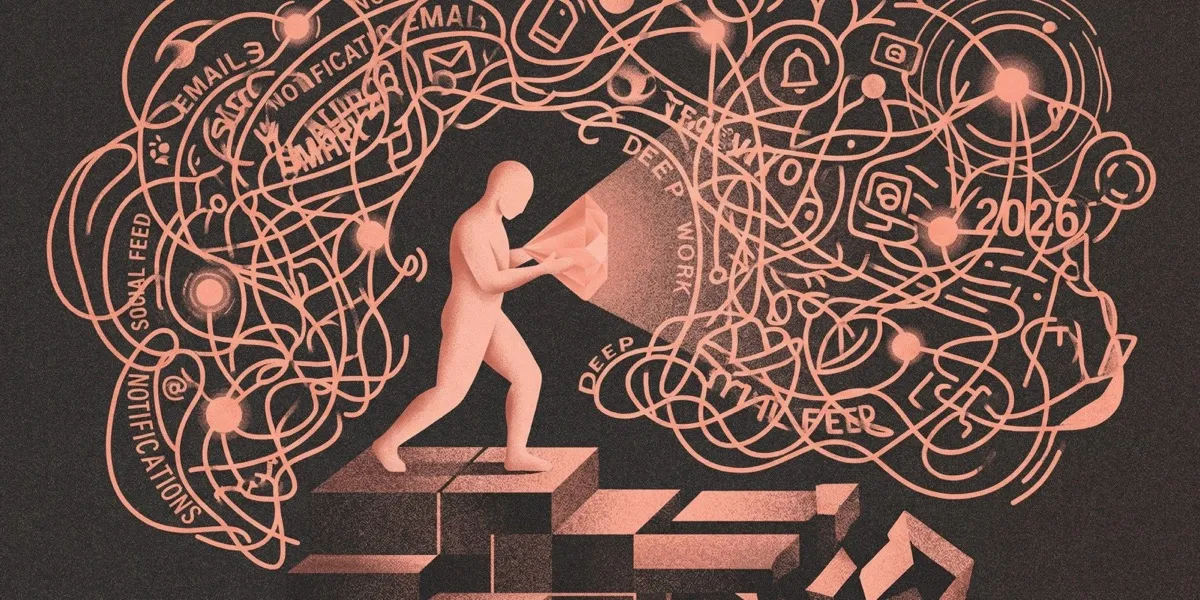
Most knowledge workers have heard of deep work, but few could define it precisely if asked. So let’s begin there.
Deep work is professional activity performed in a state of distraction-free concentration that pushes your cognitive capabilities to their limit. It is the opposite of the quick, fragmented tasks that fill most workdays - replying to messages, sitting in status meetings, updating trackers. Deep work produces results that are difficult to replicate. It creates disproportionate value. And it has become, in the last decade, one of the rarest things a person can do with their time.
Cal Newport introduced the term in his 2016 book of the same name. He argued that the ability to focus without distraction on a cognitively demanding task was becoming both increasingly rare and increasingly valuable. At the time, that felt like a sharp observation. A decade later, it reads more like an understatement.
This guide covers what deep work is, the original rules Newport laid out, the research on why attention has grown harder to hold, and three strategies that actually work under current conditions - not the conditions of 2016.
Deep work vs shallow work
Newport drew a clean line between two kinds of work.
Deep work is the kind that demands your full attention. Writing a hard essay. Designing a system. Working through a proof. Diagnosing a complex bug. Anything where the output improves with sustained, uninterrupted thought and degrades when interrupted.
Shallow work is the kind that can be done while distracted and often is - email, most meetings, logistical coordination, routine administration. It is not useless. It simply does not move the needle the way deep work does.
The problem is not that shallow work exists. The problem is that modern working environments treat both kinds as interchangeable, scheduled back-to-back in the same blocks, with the same tools. One kind produces value that compounds. The other produces activity that fills a day.
Cal Newport’s four rules of deep work
Newport’s book is long, but the framework reduces to four rules. Each one is still sound. What has changed is how much the environment now works against them.
Rule 1: Work deeply. Build rituals and routines that support sustained focus. A defined time, a defined place, and a defined minimum commitment. Without ritual, you rely on willpower, which is a thin defense.
Rule 2: Embrace boredom. Train your mind to be comfortable with the absence of stimulation. A brain that has been taught, through a thousand small rewards from a phone, to expect constant novelty cannot concentrate on command. Depth requires tolerance for quiet.
Rule 3: Quit social media. Newport’s original framing was strong, and it remains directionally correct: social media fragments attention and offers little in return for what it takes. You do not need to quit everything. You do need a clear-eyed view of what each platform is doing to your capacity for depth.
Rule 4: Drain the shallows. Aggressively reduce the time you spend on shallow work. Batch it. Schedule it. Put a ceiling on it. Shallow work expands to fill whatever container you give it, and depth has to be protected from that expansion.
These rules still hold. But they were written for a world with fewer competing demands on attention than the one you are working in now.
The attention problem is worse than you think
Gloria Mark, a professor of informatics at the University of California, Irvine, has spent over two decades studying how people allocate attention in digital environments. In her 2023 book Attention Span, she reported that the average time a person spends on any single screen before switching has dropped to 47 seconds. For context, when she began measuring this in 2004, the average was two and a half minutes. By 2012, it was 75 seconds. The trend has been moving in one direction, and it has not slowed down.
Forty-seven seconds is not a typo. It is an average. The median, Mark found, is even lower - 40 seconds, meaning half of all observations were shorter than that.
Her research also found that it takes an average of 25 minutes to fully return attention to a task after an interruption. If you are interrupted every few minutes — by a notification, a message, or even your own impulse to check something - you may never reach the depth of focus that deep work requires. You are not working. You are recovering from the last interruption, over and over again.
This is the reality that any deep work strategy must contend with now. The problem is not that people lack discipline. The problem is that the environment is designed, at almost every level, to fragment attention.
What changed since 2016
Newport’s original framework assumed a relatively stable set of distractions: email, social media, open office plans. The prescription was clear - withdraw from shallow work, create rituals, commit to depth. But several things have changed.
Remote and hybrid work blurred the boundaries. When your home is your office, the physical cues that once separated focused work from everything else disappear. There is no door to close that also closes off the dishes, the delivery, or the family member who needs something. The context that once supported depth has eroded.
AI tools created a new kind of shallow work. Interacting with AI assistants, reviewing their output, deciding what to keep and what to discard. This is cognitive work, but it is rarely deep. It sits in a grey zone: effortful enough to feel productive, fragmented enough to prevent real concentration. For many people, AI has not reduced the amount of shallow work. It has changed its texture.
The notification ecosystem expanded. In 2016, the main sources of interruption were email and a handful of messaging apps. In 2026, many knowledge workers manage notifications from email, multiple chat platforms, project tools, AI assistants, calendar reminders, and automated alerts. Each one, individually, seems harmless. Collectively, they create a constant low-level pull on attention that makes sustained focus extraordinarily difficult.
The strategies that follow are about adapting Newport’s principles to the conditions that actually exist right now.
Strategy one: define deep work blocks by energy, not by hours
The most common approach to deep work is time-blocking - setting aside a two-hour or four-hour window and committing to uninterrupted focus during that period. In theory, this works. In practice, it often fails, because it treats all hours as equal.
They are not. Your capacity for deep focus varies throughout the day, and it varies from day to day. A two-hour block scheduled at 2 PM on a day when you slept poorly and had three difficult conversations before lunch is not the same as a two-hour block at 9 AM on a rested Tuesday morning. Treating them as interchangeable is one reason people abandon deep work routines - the blocks become obligations rather than opportunities.
A more sustainable approach is to schedule deep work around your energy, not around your calendar. Pay attention, over a few weeks, to when you naturally feel most capable of concentration. For most people, this is in the morning, but not for everyone. Some people hit their stride after lunch. Others find a second window in the evening.
Once you identify your peak focus windows, protect them. Not by blocking out a rigid number of hours, but by treating those windows as the time when you do the work that matters most. On a high-energy day, the window might stretch to three hours. On a depleted day, it might be forty-five minutes. Both are fine. The goal is not a fixed quota. The goal is to consistently place your most demanding work inside the periods where your mind is best equipped to handle it.
Deep work needs a place in your day, not just good intentions. Planning on a timeline gives it one. If that approach is new to you, start with timeline planning, explained.
Strategy two: use buffer zones to protect transitions
One of the underappreciated obstacles to deep work is the transition into it. You do not sit down and immediately enter a state of deep focus. There is a ramp-up period, a few minutes where your mind is still processing the last thing you were doing, still settling into the new task. If you schedule a deep work block immediately after a meeting or a burst of email, you lose the first ten to fifteen minutes just arriving mentally.
Buffer zones solve this. A buffer is a short period - ten to twenty minutes between your shallow work and your deep work, during which you do something low-stakes and transitional. Review your notes for the deep work session. Write down the specific question you want to answer or the specific output you want to produce which also converts an open loop into a concrete plan (the Zeigarnik effect) . Clear your desk. Close unnecessary tabs. Review your past tasks, return to the context, and find gratitude for how far you’ve come to drive yourself forward. The buffer is not productive time in the traditional sense. It is preparation time, and it makes the deep work that follows significantly more effective.
A timeline day planner is useful here, because it lets you see the shape of your day and build in these transitions deliberately. When your tasks and notes sit together on flexible daily pages, you can spot the moments where a buffer is needed - the gap between a morning of calls and an afternoon of writing, or the space between wrapping up one project and starting the next. Without that visibility, buffers get compressed or eliminated, and the deep work session starts with a mind still tangled in whatever came before.
Strategy three: one deep work day per week instead of scattered sessions
This is the most counterintuitive strategy, and for many people, the most effective.
Instead of trying to carve out a deep work block every day and dealing with the daily friction of protecting it and defending it against interruptions, designate one full day per week as a deep work day. On that day, you do nothing but focused, cognitively demanding work. No meetings. No email. No chat. No shallow tasks at all.
The remaining four days become your shallow work days - communication, collaboration, administrative tasks, and everything else that requires responsiveness but not depth. You stop trying to mix the two modes in every day and instead separate them entirely.
This works for several reasons. First, it eliminates the daily negotiation with yourself about whether to protect the block or respond to “just one quick thing.” The boundary is the entire day, and that is easier to defend than a two-hour window. Second, a full day of depth allows you to reach a level of immersion that shorter blocks rarely achieve. Complex problems often require sustained attention over many hours. You cannot think your way through a difficult design problem or a strategic question in ninety-minute increments. Third, it gives your shallow work days more breathing room. When you are not trying to protect a focus block, you can be fully responsive and collaborative without guilt.
The deep work day requires planning. Choose the day, communicate it to the people who need to know, and prepare the work in advance so you are not spending the first hour figuring out what to focus on. Using flexible daily pages to lay out the deep work day the evening before - listing the questions to answer, the problems to solve, the outputs to produce - turns the day from an open expanse into a structured session.
The compound effect of protected attention
None of these strategies will eliminate distraction. The world is too noisy for that, and pretending otherwise is a recipe for frustration. What they do is create pockets of depth in a shallow environment and those pockets, over time, compound.
One deep work session per week, consistently maintained for a year, is fifty-two sessions of sustained, undistracted focus. That is fifty-two opportunities to make progress on work that actually moves your life or career forward. The people who produce exceptional work - in writing, engineering, research, design, strategy, sports - are not people who never get distracted. They are people who have built systems that protect their attention when it matters most.
The attention economy is not going to become less demanding. What you can change is how deliberately you allocate the focus you have. That is, in the end, what deep work is about, not withdrawing from the world, but choosing, with intention, where your mind goes.
Summary
Deep work is distraction-free focus on work that demands your full cognitive capacity. Cal Newport’s original four rules - work deeply, embrace boredom, quit social media, drain the shallows - remain sound. What has changed is the environment. Attention is measurably harder to hold than it was a decade ago, and the conditions that once supported depth have eroded.
The practical shift is moving from rigid time-blocking toward energy-aware scheduling, intentional transitions between shallow and deep work, and protected days of sustained focus. If you are looking for a way to structure this kind of intentional focus into your daily routine, Paso is a timeline day planner that keeps your notes and tasks together on flexible daily pages, built for people who want to plan with clarity, not complexity.
Frequently Asked Questions
What is deep work?
Deep work is a term coined by Cal Newport in his 2016 book of the same name. It refers to professional activity performed in a state of distraction-free concentration that pushes your cognitive abilities to their limit. This kind of work produces results that are difficult to replicate and creates disproportionate value compared to shallow tasks like email or routine administration.
How do I schedule deep work in a busy day?
Rather than forcing a fixed block into a packed schedule, identify when your energy for concentration is highest and protect that window first. Even a single forty-five-minute session of genuine focus, placed at the right time, produces more meaningful output than two hours of distracted effort. If daily blocks are not realistic, consider consolidating your deep work into one full day per week.
How long should a deep work session last?
There is no single correct duration. For most people, meaningful depth begins after about twenty to thirty minutes of uninterrupted focus. Sessions of sixty to ninety minutes are effective for many tasks, though complex problems often benefit from longer stretches. The key is consistency and energy, a shorter session at peak focus is more productive than a longer one when you are depleted.
Can I do deep work with notifications on?
In practice, no. Gloria Mark’s research shows that even brief interruptions require an average of 25 minutes to fully recover focus. A notification that takes three seconds to read can cost you fifteen minutes or more of depth. Turning off notifications, or putting your devices in a mode that blocks them, is not optional for deep work. It is a prerequisite.
What is the best time of day for deep work?
It varies by person, but most research on circadian rhythms suggests that analytical focus peaks in the morning for the majority of people, roughly two to four hours after waking. However, some people are naturally more focused in the afternoon or evening. The most reliable approach is to track your own energy and concentration over two to three weeks and schedule deep work during the windows where focus comes most naturally.