
The 1-3-5 rule: a realistic way to plan your day
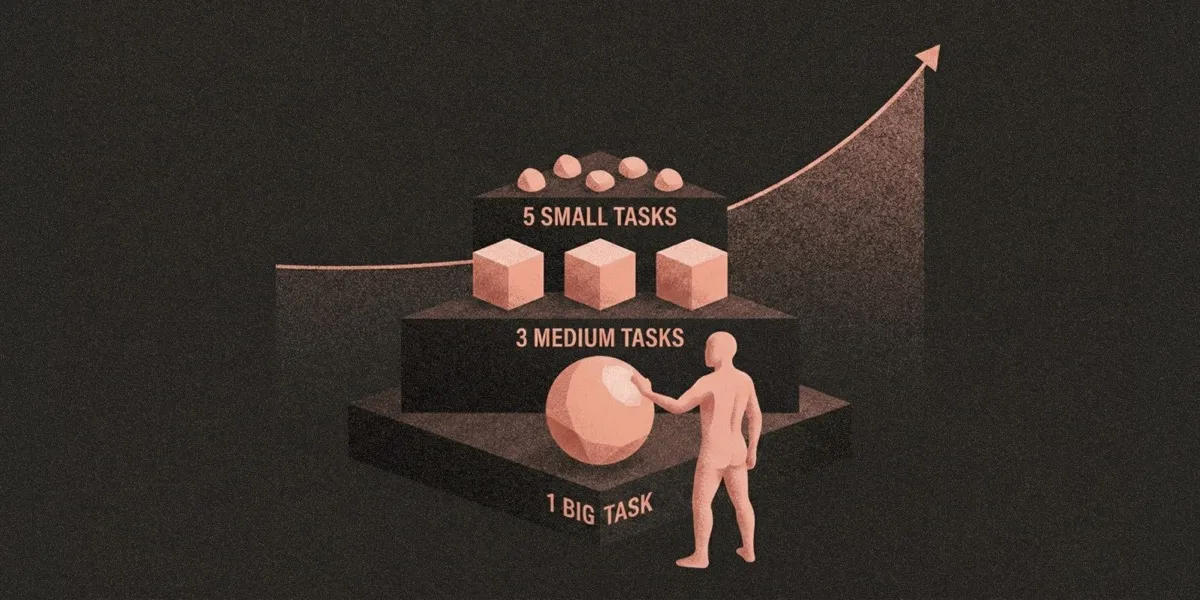
Most to-do lists are acts of fiction. We’ve written at length about why to-do lists don’t work, but the short version is this: you write down fifteen things, finish four, and carry the rest to tomorrow like debt you never asked for. After enough days like this, something subtle happens. You stop trusting your own plans. Not consciously, but somewhere in the background, your brain learns that your daily list is aspirational at best and demoralizing at worst.
The 1-3-5 rule exists to fix this. Not by making you more productive, but by making your plan more honest.
What the 1-3-5 rule is
The method is exactly what the name suggests. Each day, you plan:
- 1 big task, the most important thing on your plate.
- 3 medium tasks, meaningful work that still needs to happen.
- 5 small tasks, quick items you can knock out in minutes.
Nine items total. That is your day.
The constraint is the point. By capping the number and categorizing by size, you are forced to make decisions before the day begins. What actually matters? What can wait? What am I kidding myself about? These are the questions that long, flat to-do lists let you avoid. The 1-3-5 rule does not. If your big task often traces back to a larger ambition, pairing 1-3-5 with a goal-driven method keeps the daily step connected to the long-term why.
Why it works
It prevents overcommitment
Research on the planning fallacy shows a consistent pattern: people underestimate how long tasks will take, even when they have done similar tasks many times before. Kahneman and Tversky identified this decades ago, and the finding has held up ever since. Any planning method relying on pure intuition about capacity will trend toward overcommitment.
The 1-3-5 rule sidesteps this by imposing a structural limit. You cannot add a tenth item. You cannot pretend that today has room for three big tasks and eight medium ones. The method creates a ceiling, and that ceiling is closer to reality than most people’s instincts.
It creates hierarchy
A flat to-do list treats every item as equal. But your day is not flat. Some tasks carry more weight, more consequence, more cognitive demand. By separating tasks into big, medium, and small, you build a hierarchy that mirrors how work actually feels.
This matters because hierarchy reduces decision-making during the day. When you sit down at 9 a.m. and your list has a clear top priority, you do not waste twenty minutes wondering where to start. The structure has already answered that question.
It makes finishing possible
This is the psychological core of the method. When you write nine tasks and finish nine tasks, your brain registers completion. That may sound trivial, but it is not. Teresa Amabile and Steven Kramer found that the single most powerful driver of positive work experience was making meaningful progress. They called it the progress principle: small wins accumulate and build a sense of momentum that feeds forward into the next day.
A to-do list with twenty items and twelve crossed off feels like failure. A 1-3-5 list with all nine done feels like a day well spent. Same amount of work, possibly. Very different psychological effect.
How to define big, medium, and small
This is where most people get stuck. The categories are not just about time, they are about a combination of time and cognitive effort.
Big tasks typically require 90 minutes to three hours of focused work. They demand concentration, creativity, or sustained problem-solving. You cannot do them in the cracks between meetings. They need a dedicated block of your best energy.
Medium tasks take 30 to 60 minutes. They require some thought but not deep immersion. You can start them, get interrupted, and come back without losing much momentum.
Small tasks take 5 to 15 minutes each. They require minimal cognitive effort, sending an email, scheduling a call, reviewing a document. The kind of thing you can handle when your energy is low or your focus is fragmented.
A useful test: if a task makes you think “I need to set aside time for that,” it is probably big. If you think “I should get to that today,” it is medium. If you think “I just need to remember to do it,” it is small.
Once you know which tasks are big, medium, and small, placing them on a timeline view gives you a natural home for each size.
Three days with the 1-3-5 rule
A programmer’s day
Big:
- Implement the new authentication flow for the user dashboard.
Medium:
- Review pull requests from two teammates.
- Write unit tests for the payment module.
- Update the API documentation for the new endpoints.
Small:
- Reply to the Slack thread about the staging environment.
- Update the Jira ticket status for the completed bug fix.
- Send the tech lead the link to the monitoring dashboard.
- Schedule the sprint retrospective for Friday.
- Approve the design handoff in Figma.
Notice the shape. The big task is the one requiring deep focus, building a feature. The medium tasks are real work but interruptible. The small tasks are the connective tissue of teamwork: messages, updates, scheduling.
A freelancer’s day
Big:
- Write the first draft of the client’s landing page copy.
Medium:
- Revise the logo concepts based on client feedback.
- Send the invoice for the completed branding project.
- Research competitors for the new pitch deck.
Small:
- Reply to the prospective client’s inquiry email.
- Post the portfolio update to LinkedIn.
- Download the stock images for the newsletter template.
- Back up the project files to cloud storage.
- Confirm tomorrow’s video call with the agency.
Here the freelancer’s big task is creative work that needs a clear head. The medium tasks are substantive but varied. The small tasks are the administrative upkeep that freelancers know too well, the kind that mushrooms into chaos if ignored.
A student’s day
Big:
- Write the methodology section of the research paper.
Medium:
- Read and annotate the two assigned journal articles.
- Complete the problem set for statistics class.
- Prepare talking points for the group project meeting.
Small:
- Email the professor about the deadline extension.
- Return the overdue library book.
- Print the reading for tomorrow’s seminar.
- Check the grade posted for last week’s quiz.
- Sign up for the study group session next Thursday.
The student’s big task is the one that requires sustained thinking. Medium tasks are significant but bounded. Small tasks are the logistical minutiae that pile up when you are managing a semester.
When the 1-3-5 rule does not work
No planning method is universal. The 1-3-5 rule has a specific weakness: days dominated by meetings.
If you have five or six hours of meetings, you do not have the space for one big task, three medium ones, and five small ones. Attempting to fit a full 1-3-5 list around a packed calendar leads to exactly the kind of overcommitment the method was designed to prevent.
On heavy meeting days, be honest about your capacity. You may have time for a few small tasks between calls and one medium task if you protect an hour somewhere. That is not a failure of the method. That is the method working, it forces you to see what your day can realistically hold, even when the answer is less than you would like.
Variants worth trying
The 1-3-5 structure is a starting point, not a commandment. Two variations are worth knowing.
The 1-2-3 rule for heavy days
When your day is partially consumed by meetings, travel, or appointments, scale down. One big task, two medium, three small. Six items instead of nine. This preserves the hierarchy (you still have a clear top priority) while respecting the reality that not every day offers eight hours of productive time.
Some people use 1-2-3 as their default and treat 1-3-5 as an ambitious-day format. That works. The point is to match the structure to the day, not force the day into the structure.
The 1-3-5-X rule for ambitious days
On rare days when your calendar is clear and your energy is high, you might add an X category: extra tasks you will attempt if you finish everything else. These are explicitly optional. They sit below the line, psychologically separate from the nine items you committed to.
The key is that X tasks carry no obligation. If you get to them, good. If you do not, your day was still complete. This prevents the common trap of expanding your list on good days and then feeling inadequate when you cannot maintain that pace tomorrow.
Building trust in your own planning
The deepest benefit of the 1-3-5 rule is not efficiency. It is trust.
When you consistently plan nine things and finish nine things, something shifts in how you relate to your own intentions. You start believing that when you write something down in the morning, it will actually happen by evening. That belief changes behavior. You become more willing to plan because planning has proven itself reliable. You become more honest about what a day can hold because the structure demands honesty.
This is the opposite of what happens with overloaded to-do lists. Those teach you, slowly and without you noticing, that your plans are unreliable. That “I will do this today” actually means “I hope to do this today but probably will not.” That erosion of self-trust is quiet, but it has real consequences. It makes you less likely to commit to important work. Less likely to set ambitious goals. Less likely to plan at all.
The 1-3-5 rule rebuilds that trust by making your plans achievable by design. Not because the tasks are trivial, but because the structure matches the reality of what one person can do in one day.
Summary
The 1-3-5 rule is a daily planning method that caps your to-do list at nine items: one big task, three medium tasks, and five small ones. It works because it prevents overcommitment, creates a natural hierarchy, and (most importantly) makes it possible to finish what you planned. Over time, that builds a kind of momentum that no twenty-item to-do list can match. If you want a planner that gives you a clean daily page with room for exactly one big thing, three medium things, and five small ones (no more, no less) Paso was designed around that kind of honest, structured planning.
Frequently Asked Questions
What is the 1-3-5 rule?
The 1-3-5 rule is a daily planning method where you limit your to-do list to nine items: one big task, three medium tasks, and five small tasks. The structure prevents overcommitment by capping the total number of tasks and organizing them by size. The “big” task is your top priority for the day, the thing that requires the most focus. Medium tasks are meaningful but manageable. Small tasks are quick items that take 5 to 15 minutes each. The method works because it matches your plan to a realistic assessment of what one day can hold.
How do I decide what counts as a “big” task?
Consider two factors: time and cognitive effort. A big task typically requires 90 minutes to three hours and demands deep concentration, writing, designing, coding, strategic thinking. The simplest test is whether the task needs a protected block of uninterrupted time. If you cannot do it in the cracks between meetings or errands, it is big. If you find yourself with two tasks that both feel big, one of them moves to tomorrow. That is the discipline the method requires.
Can I adjust the 1-3-5 rule for busy days?
Yes. On meeting-heavy days or days with other fixed commitments, scale down to a 1-2-3 format: one big task, two medium, three small. This preserves the core benefit (a clear hierarchy with a realistic total) while respecting the fact that not every day offers the same amount of working time. Some people use 1-2-3 as their default and treat 1-3-5 as the version for days with more open time. The structure should serve the day, not the other way around.
Is the 1-3-5 rule better than a regular to-do list?
It depends on your relationship with your to-do list. If you regularly write long lists and finish most items, a flat list works for you. But if you often end the day with more unfinished tasks than finished ones (and if that pattern has made you less likely to plan at all) the 1-3-5 rule addresses the root problem. By limiting the total and sorting by importance, it creates a list you can actually complete. That completion effect is what makes the difference over time: you start trusting your own plans, which makes you more likely to keep planning.
How long should I spend on each category of tasks?
As a rough guide: your big task will occupy two to three hours at the core of your day. Your three medium tasks will fill another two to three hours combined, roughly 30 to 60 minutes each. Your five small tasks will take 30 to 60 minutes total, scattered through the day. That adds up to roughly five to seven hours of productive work, which lines up with what we know about daily productivity. A widely cited Vouchercloud survey found that the average office worker is productively engaged for under three hours per day, though that figure likely reflects environments with significant meeting and communication overhead. The 1-3-5 rule sets a more intentional target while leaving room for the inevitable interruptions, transitions, and mental breaks that fill a real workday.