The problem with productivity systems (and why simple wins)
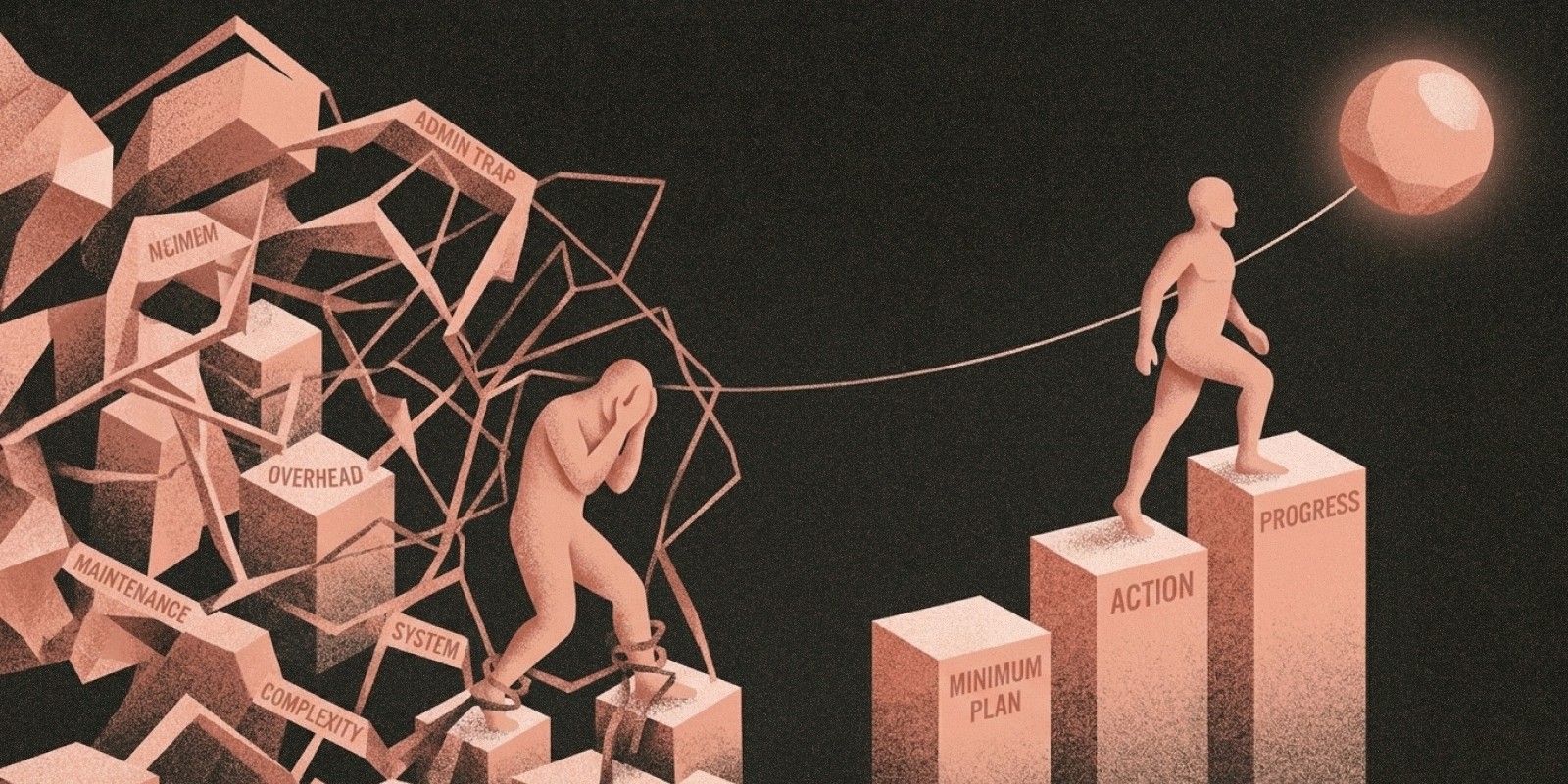
You discover a new productivity system. You watch the videos. You read the book or the blog post or the long Reddit thread. You set everything up, the folders, the tags, the templates, the weekly review process. For a few days, maybe a week, it feels like you have finally found the answer.
Then it collapses. Not dramatically. Quietly. You skip the weekly review. The inbox piles up. The carefully constructed hierarchy of projects, areas, resources, and archives starts to feel like a second job. Eventually you stop using it altogether and go back to whatever you were doing before.
This is not a personal failure. It is a pattern, one so common it might as well be a law of nature.
The golden age of productivity complexity
We are living through an era of remarkably sophisticated personal productivity systems. David Allen's Getting Things Done (GTD) introduced the concept of the "trusted system", an external repository for every open loop in your life. Tiago Forte's Building a Second Brain described the PARA method for organizing all personal knowledge into Projects, Areas, Resources, and Archives. The Zettelkasten method, drawn from sociologist Niklas Luhmann's practice of maintaining a vast interconnected note system, has been adapted into digital tools and workflows.
Each of these systems contains genuine insight. Allen's observation that unprocessed commitments create mental overhead connects to the Zeigarnik effect, the finding that incomplete tasks are remembered better than completed ones, persisting in memory until resolved. Forte's emphasis on capturing ideas before they vanish is consistent with what we know about the unreliability of memory. Luhmann's interconnected notes produced extraordinary academic output.
The ideas are sound. The problem is not the ideas. The problem is what happens when ordinary people try to implement them in full.
Meta-work: the hidden tax
There is a concept worth naming here: meta-work. Work about work instead of actual work.
Meta-work is the time you spend organizing your task manager instead of doing tasks. It is the thirty minutes you spend deciding which folder a note belongs in. It is the weekly review that takes ninety minutes because your system has accumulated so many categories, contexts, and open loops that processing them all is itself a significant project.
Some amount of meta-work is unavoidable and even valuable. You need to spend some time organizing your work in order to do it well. The question is one of proportion. When the system designed to help you work more effectively begins consuming a meaningful percentage of your working hours, something has gone wrong.
This is not a hypothetical problem. If you have spent time in online productivity communities (the subreddits, the Discord servers, the YouTube comment sections) you will recognize a familiar pattern. People spend months building elaborate Notion dashboards, perfecting their tag taxonomies, debating the optimal structure for their Zettelkasten. The system becomes the hobby. The work it was supposed to support recedes into the background.
Cal Newport, in Slow Productivity, argues for what he calls "doing fewer things" as one of three core principles. His broader point is that modern knowledge workers have been pulled into a state of constant busyness that feels productive but is not. Elaborate personal productivity systems can become a sophisticated form of that same trap, a way of feeling organized without necessarily accomplishing more of what matters.
Why complexity is so appealing
If complex systems fail so often, why do people keep building them?
Because complexity feels like competence. A sophisticated system with nested folders and interconnected databases and automated workflows looks like the kind of thing a serious, capable person would maintain. Simplicity, by contrast, can feel amateur. Writing three things on a piece of paper does not feel like enough.
There is also a deeper psychological pull. Setting up a system activates the same reward pathways as planning a vacation, you get to imagine a better future without doing the hard work of living in it. The system promises a version of yourself who is organized, on top of everything, never forgets a commitment. That vision is intoxicating. Actually following through on your work, day after day, is far less glamorous.
And there is a selection effect in productivity content. The people who write about and teach complex systems are, almost by definition, people who enjoy maintaining complex systems. Their enthusiasm is genuine. But their tolerance for meta-work is far higher than the average person's. What feels like a pleasant Sunday evening ritual to a productivity enthusiast feels like homework to everyone else.
The case for minimum viable planning
There is an alternative to all of this, and it is not exciting. That is part of its strength.
The concept is minimum viable planning: the smallest amount of planning structure that still gives you direction for the day. Not a comprehensive life management system. Not a second brain. Just enough scaffolding to know what matters today and roughly when you intend to do it.
What does that look like in practice? For most people, it is remarkably simple. Look at today. Decide on the two or three things that matter most. Place them loosely in the flow of your day. Start working. That is it.
This approach draws on a principle that Newport has articulated across his work: the value of doing fewer things with more intention rather than managing an ever-expanding list of commitments. It also aligns with research on implementation intentions, psychologist Peter Gollwitzer's work showing that simply linking a task to a specific time or context significantly increases the likelihood of follow-through. You do not need an elaborate system to benefit from this. You need a plan for today.
The resistance to this idea is predictable. It feels like it cannot possibly be enough. What about your long-term projects? What about your someday-maybe list? What about all the ideas you might want to revisit in six months?
Those are real concerns. But here is what most people discover when they let go of comprehensive systems: the important things do not get forgotten. They come back. They nag at you. The truly important projects and ideas have a way of persisting without a folder to live in. And the things that do get forgotten? They were probably not that important.
Simplicity is harder than it looks
There is a paradox at the center of this argument. Simple systems are harder to commit to than complex ones.
Complex systems give you things to do when you are avoiding real work. You can reorganize your tags. You can refine your dashboard. You can process your inbox. All of this feels productive. It gives you the sensation of making progress without requiring you to face the discomfort of your actual priorities.
A simple system offers no such hiding places. When your entire planning process takes three minutes, you are left with the rest of the day and no excuse not to spend it on what matters. That directness is uncomfortable. It is also the point.
This is why, counterintuitively, the people who are most drawn to complex productivity systems are often the ones who would benefit most from abandoning them. The complexity is not solving a problem. It is providing a sophisticated form of procrastination, one that feels like work and therefore escapes scrutiny.
What actually matters
Strip away the methodologies, the frameworks, the acronyms, and you are left with a few things that genuinely help people get work done.
Clarity about today. Not this quarter. Not this year. Today. What matters in the next eight to twelve hours? Most people can hold two or three priorities. That is enough.
Tasks placed in time. A task on a list exists in the abstract. A task placed at a specific point in your day exists in reality. The difference in follow-through is significant.
A ritual, not a system. Something you do at the same time, in the same way, that takes minutes rather than an hour. Something your brain can do on autopilot rather than something that requires fresh motivation each time.
Permission to let things go. Not everything needs to be captured. Not every idea deserves a permanent home. The willingness to let non-essential things slip away is not carelessness. It is focus.
These principles do not sell books. They do not make for impressive YouTube tutorials. They do not require a specific app or a specific methodology. They are boring. They also work.
Summary
Most productivity systems fail not because people lack discipline but because maintaining the system becomes work in itself, meta-work that crowds out the actual tasks the system was built to support. The alternative is minimum viable planning: enough structure to give your day direction, and nothing more. Sometimes all you need is a planner with flexible daily pages, a few minutes of intention each morning, and the willingness to keep it that simple. That is what Paso is, and nothing more.
Frequently Asked Questions
Why do productivity systems fail?
Most productivity systems fail because they require more maintenance than people can sustain. The initial setup feels rewarding, but the ongoing work of processing inboxes, conducting weekly reviews, and maintaining category structures eventually becomes a burden. When the overhead of running the system approaches or exceeds the time saved by having it, people abandon it, not from laziness, but from a rational assessment that the cost has exceeded the benefit.
What is meta-work in productivity?
Meta-work is work about work rather than the work itself. It includes organizing your task manager, deciding how to categorize a note, refining your project templates, conducting system reviews, and debating workflow optimizations. Some meta-work is necessary, you cannot be productive without any planning or organization. The problem arises when meta-work expands to fill a significant portion of your day, displacing the tasks it was supposed to support.
Is GTD too complex for most people?
GTD contains valuable ideas, particularly the insight that unprocessed commitments create mental overhead and the practice of defining next actions rather than vague to-dos. However, the full implementation, with its multiple lists, contexts, weekly reviews, and processing workflows, requires a level of sustained meta-work that many people find unsustainable. The principles behind GTD are sound. The issue is that implementing the complete system demands a tolerance for organizational maintenance that most people simply do not have.
What is the simplest productivity method?
The simplest effective method is what might be called minimum viable planning: at the start of each day, decide on two or three priorities and place them loosely in the flow of your day. No categories, no tags, no weekly reviews. Just a clear answer to the question "what matters today?" combined with a rough sense of when you will do each thing. This approach leverages research on implementation intentions while avoiding the overhead of more elaborate systems.
How do I know if my system is too complicated?
A useful test: if you regularly spend more time managing your productivity system than you spend on your three most important tasks of the day, your system is too complicated. Other signs include feeling guilty when you skip a weekly review, spending significant time deciding where to file a note or task, and finding that the system itself has become a source of stress rather than relief. The purpose of a productivity system is to reduce friction, not create it. If yours is adding friction, it is time to simplify.